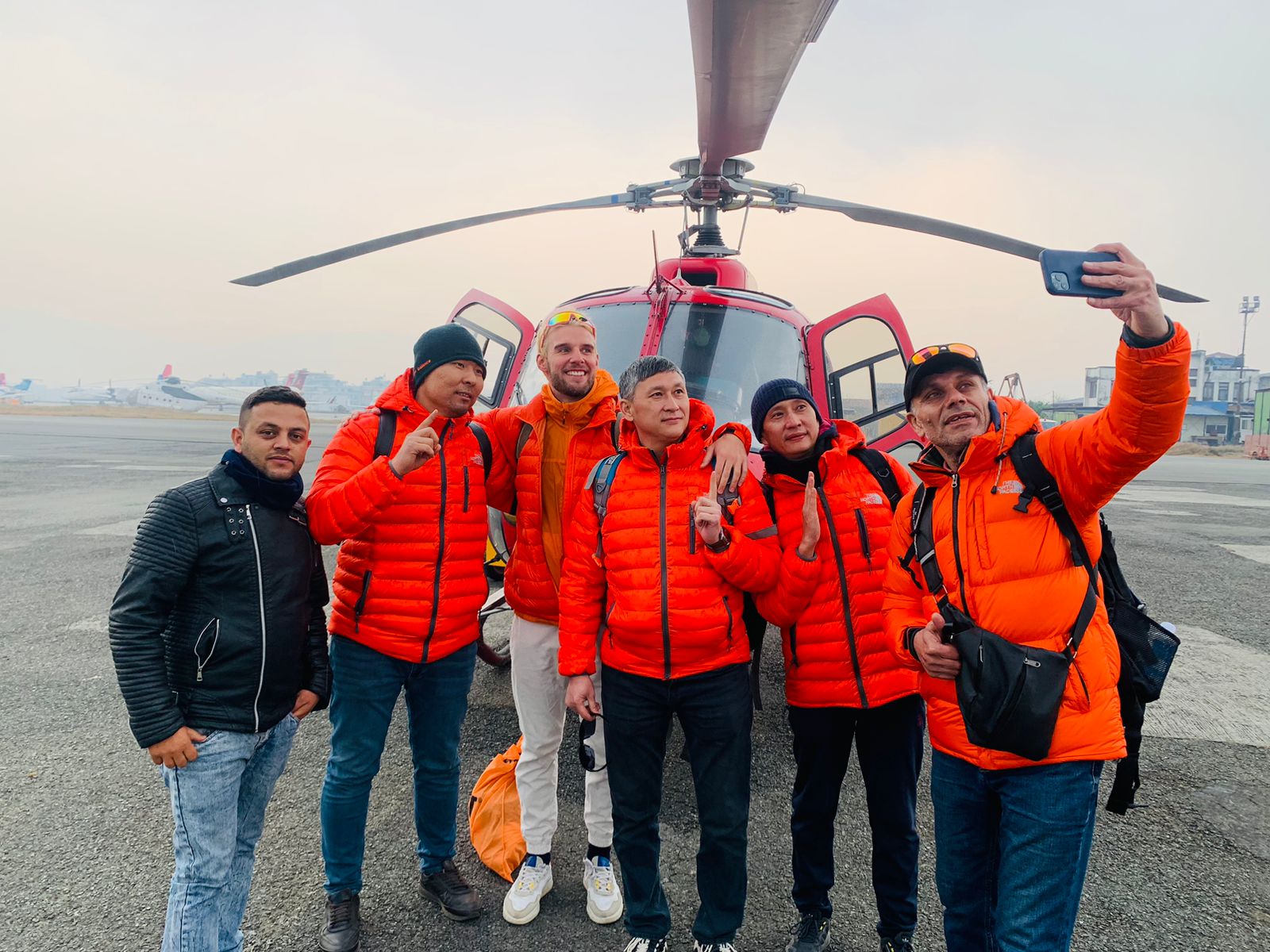
A helicopter trip to Everest Base Camp covers the entire Khumbu region in a single morning: Kathmandu departure, a refueling stop at Lukla Airport (2,860m), an aerial pass over the Khumbu Glacier and Everest Base Camp (5,364m), a 15 to 20-minute landing at Kala Patthar (5,545m) for unobstructed views of Mount Everest's summit, and breakfast at Hotel Everest View (3,880m) in Syangboche before returning to Kathmandu. Total duration is 4 to 5 hours. No trekking days, no altitude acclimatization schedule, no Lukla flight logistics. For travelers who want the Everest region experience without 12 to 14 days on the trail, this is the most direct option available.
What most competitor pages skip: the shuttle system at Kala Patthar. At 5,545 meters, helicopter performance is significantly reduced. The aircraft cannot carry a full passenger load at that altitude. Groups of 4 to 5 passengers are divided at Pheriche (4,371m), with the first shuttle flying 2 to 3 passengers to Kala Patthar, landing, returning to collect the remaining passengers, then making the ascent again. This adds 30 to 45 minutes to the itinerary. World Expedition Nepal builds this into the schedule so it does not catch you off guard.
The Everest Base Camp helicopter tour operates year-round but is best in spring (March to May) and autumn (September to November), when pre-dawn mountain visibility is highest, and Kala Patthar landing conditions are most stable.
The Everest Base Camp Trek takes around 12 to 14 days and requires physical fitness, acclimatization, and multiple days of walking in high altitude conditions.
The helicopter trip to Everest Base Camp reaches the same Everest region within a few hours. Travelers can experience aerial Everest viewing, glacier scenery, Sherpa villages, and Himalayan landscapes without trekking.
The Everest helicopter tour is ideal for:
Travelers with limited time
Luxury adventure travelers
Families and senior travelers
Photographers and content creators
Travelers unable to complete the Everest Base Camp Trek
The helicopter trip to Everest Base Camp is suitable for travelers who want a comfortable Everest experience without long trekking days.
This tour is especially popular among:
Luxury travelers seeking a premium Himalayan experience
Honeymoon couples
Families with children
Elderly travelers
First-time visitors to Nepal
Travelers with limited trekking ability
Adventure travelers short on time
The Everest region contains some of the world’s most dramatic mountain scenery. A helicopter flight provides an aerial perspective of the Himalayas that is impossible to experience from roads or lower-altitude tours.
The combination of Everest Base Camp, Kala Patthar landing, Khumbu Glacier views, and breakfast at Hotel Everest View makes this a bucket-list travel experience in Nepal.
The tour includes aerial Himalayan flights, Everest and glacier views, Kala Patthar landing, Hotel Everest View breakfast, Sherpa village flyovers, and photography opportunities. It combines high-altitude landscapes and cultural scenery in one time-efficient luxury experience.
The Everest helicopter tour flies above deep valleys, snow-covered peaks, glaciers, and Sherpa settlements. The route provides a complete Himalayan scenic flight in Nepal in a single day.
During the flight, travelers see Mount Everest, Lhotse, Nuptse, Ama Dablam, and the Khumbu Glacier from close range. The aerial Everest panorama flight also reveals the rugged icefall terrain surrounding Everest Base Camp.
Kala Patthar is the main landing point of the helicopter trip to Everest Base Camp. Located above 5,500 meters, it provides the best close-up view of Mount Everest.
Most tours include a stop at Hotel Everest View for breakfast and mountain photography. The hotel overlooks Everest, Ama Dablam, and the surrounding Himalayan peaks.
The helicopter tour is one of the best Everest photography flight tours in Nepal. Morning flights provide clear lighting conditions for glacier and mountain photography.
The route crosses Sagarmatha National Park and several Sherpa settlements, including Namche Bazaar. Travelers can observe traditional mountain villages and Himalayan landscapes from above.
The helicopter trip to Everest Base Camp allows travelers to experience the Everest region without spending weeks trekking through high-altitude terrain.
The route starts from Kathmandu to Lukla, followed by a flight over the Everest region, the Khumbu Glacier, and the Everest Base Camp. It includes Kala Patthar landing, Hotel Everest View stop, and return flight via Lukla to Kathmandu.
The tour begins with a helicopter flight from Kathmandu to Lukla Airport, the gateway to the Everest region.
Most flights stop briefly at Lukla Airport for helicopter refueling before continuing toward Everest Base Camp and Kala Patthar.
After Lukla, the helicopter flies across the Khumbu region, offering aerial views of Everest Base Camp, Khumbu Glacier, and the surrounding Himalayan landscape.
Kala Patthar landing is the main highlight of the helicopter trip to Everest Base Camp. Due to altitude exposure and aviation safety standards in Nepal, landing time is limited.
The tour includes a breakfast stop at Hotel Everest View, one of the highest luxury hotels in the world.
After the Everest region sightseeing experience, the helicopter returns through Lukla and back to Kathmandu.
The tour costs around USD 1300 per person for group joining. Private charters cost significantly more but offer exclusivity and flexibility. Pricing depends on group size, season, weather conditions, and aircraft availability.
The Everest Base Camp helicopter tour cost starts from USD 1300 per person for a group joining flight.
Group joining tours are the most affordable option. Costs are shared between passengers based on total seat occupancy and weight distribution.
Private Everest helicopter charters cost significantly more but provide exclusive use of the helicopter and flexible departure timing.
Shared helicopter tours reduce overall cost, while private charters provide greater flexibility, privacy, and personalized flight experiences.
Several factors affect pricing:
Group size
Weather conditions
Seasonal demand
Flight duration
Landing permissions
Helicopter type
For travelers unable to complete the Everest Base Camp Trek, the helicopter trip to Everest Base Camp provides the fastest and most comfortable way to experience the Everest region.
Flights follow CAAN aviation standards with trained pilots and safety protocols. Oxygen is available onboard, and operations depend strictly on weather conditions. Weight limits, altitude rules, and shuttle protocols ensure safe high-altitude helicopter operations.
All Everest helicopter flights operate under Nepal Civil Aviation Authority regulations and mountain aviation protocols.
Pilots operating Everest flights are trained specifically for Himalayan aviation routes and high altitude flying conditions.
Emergency oxygen support is carried on Everest helicopter tours as a standard safety precaution.
Flights operate only when weather conditions are safe for Himalayan aviation.
Although the helicopter minimizes physical exertion, altitude sickness risk Nepal helicopters still exists due to rapid altitude gain.
Passengers must follow crew instructions during boarding, landing, photography stops, and high altitude movement.
This is the most underexplained aspect of the Everest helicopter tour across all competitor pages.
At Kala Patthar (5,545m), thin air reduces helicopter lift capacity significantly. The standard Eurocopter AS350 B3 helicopter used on this route carries up to 5 passengers at lower altitudes but is weight-limited to 2 to 3 passengers for the Kala Patthar landing.
Weight rules:
Total group weight, including clothing, camera, and small bag, must be declared honestly
For 3 passengers landing at Kala Patthar: maximum combined weight 240 kg
For 5 passengers at lower altitudes (Hotel Everest View, Pheriche): maximum 460 kg
Passengers over the weight threshold for the Kala Patthar shuttle will be grouped into separate rotations
Each additional shuttle rotation costs approximately USD 500
Declare your actual weight at check-in. Operators weigh passengers at the airport. Understating weight creates operational problems at altitude and delays the tour for the entire group.
Helicopter flight from Kathmandu to Lukla, Khumbu region, Kala Patthar, Hotel Everest View, and return
Sagarmatha National Park entry permit
Khumbu Pasang Lhamu Rural Municipality permit
Kathmandu airport tax
Lukla airport tax
Hotel pickup and transfer to Kathmandu domestic terminal
Experienced helicopter crew with Himalayan high-altitude flying certification
Hotel Everest View breakfast (optional, USD 32 to 40 per person)
Nepal visa fees
Travel insurance
Tips for crew and airport staff
Extra shuttle charge at Kala Patthar if applicable
Personal expenses
The Everest helicopter tour takes 4 to 5 hours total, including Kathmandu pickup, Lukla stop, Kala Patthar landing, Hotel Everest View breakfast, and return flight. Active flying time is about 2.5 to 3 hours.
The standard landing is Kala Patthar at 5,545 meters, offering direct Everest views. Everest Base Camp landing is possible only on select private charters with extra permits and operational clearance from aviation authorities.
Group joining costs around USD 1240 to 1300 per person plus permits. Private charter costs USD 5100 to 6500 per flight for up to five passengers, depending on season, demand, and helicopter availability.
Yes, it follows strict aviation safety standards with trained pilots and weather-controlled operations. Flights only proceed under safe visibility conditions. Oxygen support, weight limits, and altitude protocols further ensure passenger safety throughout the journey.
October is best due to clear skies and stable weather. April is second-best with excellent visibility. March, May, and November are also suitable. Monsoon months are the least reliable due to cloud cover and flight disruptions.
October and April offer the best visibility and stable weather. March and May are good alternatives. Winter is cold but clear. Monsoon months are least reliable due to cloud cover and frequent flight disruptions.
October (best single month): Post-monsoon air has zero haze. Kala Patthar landing conditions are the most reliable of the year. Pre-dawn departures give the clearest views before cloud builds over the upper Khumbu by mid-morning. Demand is highest, so book 4 to 6 weeks ahead.
April (second-best): Spring mountain clarity is excellent. The Khumbu shows rhododendron bloom on the lower valley sections visible from the air below 4,000 meters. Slightly warmer temperatures at Kala Patthar compared to autumn.
March and May: Good conditions with marginally higher weather variability than October and April. Acceptable for most departures.
November: Reliable into mid-November. The temperature at Kala Patthar drops to -15°C to -20°C before dawn. The helicopter tour departs early morning, so the cold on the ground at 5,545m is significant. Pack a down jacket rated to at least -15°C.
December to February: Operational but cold. Kala Patthar temperatures can reach -20°C to -25°C at departure time. Passenger comfort and photography conditions are reduced. Flight delays increase due to occasional snowfall above 4,000 meters.
Monsoon (June to August): Cloud cover frequently closes the Khumbu above 4,000 meters by mid-morning. Departures are attempted on clear days but cancellation rates are highest in this period. Not recommended if you have a fixed Nepal travel window.
All Everest helicopter tours depart between 6:00 and 7:00 AM to use the stable morning weather window before cloud builds over the Khumbu Valley. If the weather at any point on the route (Kathmandu, Lukla, Pheriche, or Kala Patthar) falls below aviation visibility minimums, the flight is delayed or cancelled.
When your flight is delayed, you wait at the Kathmandu domestic terminal for a weather update. Departures can often proceed 1 to 3 hours after an initial hold if conditions improve. Delays past 10:00 AM make Kala Patthar landings unlikely as cloud cover develops.
When your flight is cancelled, World Expedition Nepal reschedules to the next available clear morning. No refund is issued for weather cancellations, but rescheduling is handled at no additional cost. This is standard across all Nepal helicopter operators and reflects the operational reality of high-altitude mountain flying.
Travel insurance note: Your policy should specifically cover weather-related activity cancellation and trip delay. Standard travel insurance policies vary on this. Check the "weather cancellation" clause explicitly before traveling to Nepal for this tour.
The Everest Base Camp helicopter tour reaches 5,545 meters at Kala Patthar. At this altitude, oxygen concentration is approximately 51% of sea level. The landing stop is kept short specifically because most passengers are not acclimatized.
Common symptoms during the Kala Patthar stop: mild shortness of breath, light-headedness, and rapid heartbeat. These are normal physiological responses to sudden altitude exposure and resolve within minutes of returning to a lower altitude during the descent to Hotel Everest View (3,880m).
Who can join: The Everest helicopter tour is suitable for most ages and fitness levels. No trekking fitness is required. Children above 3 years old can join with parental supervision. Senior travelers with controlled cardiovascular conditions can join, but should consult a doctor before booking.
Who should avoid: Anyone with uncontrolled high blood pressure, severe respiratory conditions, or a documented history of HAPE or HACE at altitude should seek medical clearance before booking a helicopter tour that lands above 5,000 meters.
The helicopter operator does not carry supplemental oxygen onboard for passengers on standard tours. The landing time is intentionally brief (15 to 20 minutes) to limit altitude exposure for non-acclimatized passengers.
Two permits are required for the Everest Base Camp helicopter tour landing. World Expedition Nepal handles both before your departure day.
Sagarmatha National Park Permit: USD 25 per person for foreign nationals. Covers entry into the national park area, overflown and landed in during the tour.
Khumbu Pasang Lhamu Rural Municipality Permit: USD 25 per person. Required for all visitors to the Khumbu region, including helicopter passengers.
Both permits are processed through World Expedition Nepal using a copy of your passport. Bring your original passport on the day of the tour as checkpoints may verify documents.
Down jacket rated to -15°C minimum (Kala Patthar ground temperature in autumn averages -10°C to -15°C; November to February requires -20°C rated gear)
Warm gloves and a hat for the Kala Patthar stop
UV-blocking sunglasses (UV intensity at 5,545m is extreme)
SPF 50+ sunscreen
Camera with a fully charged battery (cold temperatures drain batteries faster at altitude)
Small daypack under 5 kg (no large luggage permitted)
Valid passport
Enjoy the popular trekking and tour packages in Nepal Himalayas. 2026.
 3 Days
 US$390
 US$599

 8 Days
US$799
8 Days
US$799
 2 Days
US$150
2 Days
US$150
 1 Day
US$550
1 Day
US$550


© 2011 - 2026 All rights reserved. World Expedition Nepal Developed By : Xenatech Nepal
 Recommended On
 US$1300

 , Bhutan